




The Difference Between Black Silicon Carbide and Green Silicon Carbide
 Sep 09, 2025|
 Silicon carbide is an important inorganic non-metallic material with excellent physical and chemical properties. It is divided into black silicon carbide and green silicon carbide.
The main differences between black silicon carbide and green silicon carbide are:
Color and physical properties. Black silicon carbide is typically black and has high hardness and mechanical strength, with a Mohs hardness of approximately 9 to 9.5. Green silicon carbide is green or light green and has high hardness and mechanical strength, with a Mohs hardness between corundum and diamond.
Chemical properties. Green silicon carbide has better chemical stability and corrosion resistance, and can withstand more chemical attacks.
Applications. Due to its high toughness and hardness, black silicon carbide is typically used for machining materials with lower tensile strength, such as glass, ceramics, stone, refractories, cast iron, and non-ferrous metals. Due to its high hardness and chemical stability, green silicon carbide is suitable for machining cemented carbide, titanium alloys, optical glass, and is also commonly used for honing cylinder liners and precision grinding high-speed steel cutting tools. Price: Green silicon carbide is generally more expensive than black silicon carbide, primarily due to its higher production costs, raw material purity, and product quality requirements.
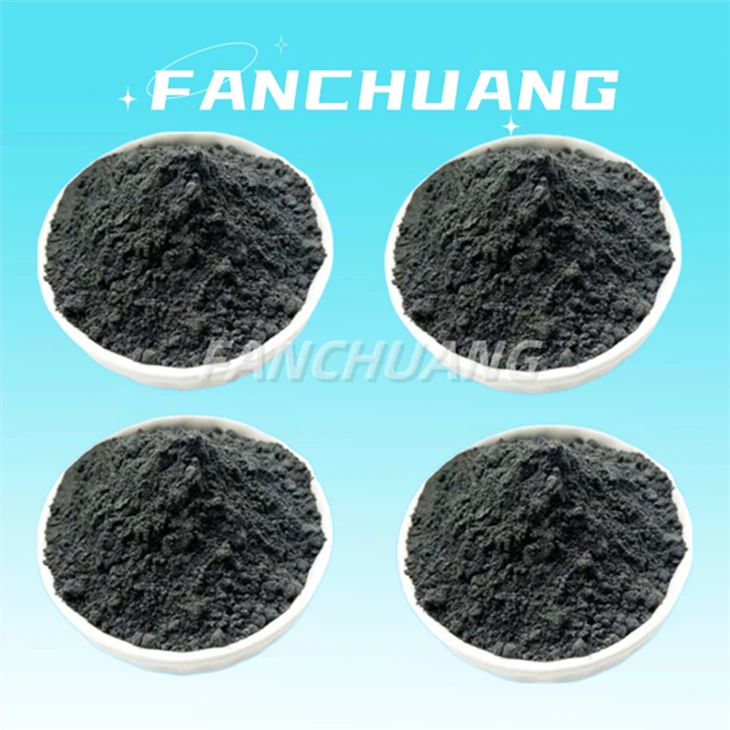
The production process for black silicon carbide primarily involves the following steps:
High-temperature smelting: Quartz sand, petroleum coke (or coal coke), sawdust, and other raw materials are mixed in a specific ratio and placed in a resistance furnace for high-temperature smelting. The resulting product is silicon carbide blocks.
Crushing: Due to its high hardness, between that of white corundum and diamond, and its large blocks, conventional crushers make it difficult to crush. Therefore, a jaw crusher is required for coarse crushing.
Fine crushing: After coarse crushing, silicon carbide is crushed in a cone crusher to produce various sizes.
Screening: The finely crushed silicon carbide is screened to produce silicon carbide sand of varying particle sizes.
Black silicon carbide has a wide range of applications, including functional ceramics, refractories, abrasives, and metallurgical raw materials.
The production process for green silicon carbide is slightly different, with the following key steps:
Raw material crushing: A hammer mill is used to crush petroleum coke to the required particle size.
Ingredient mixing: Petroleum coke, high-quality silica, and other raw materials are weighed and mixed according to the specified formula to uniformly mix.
High-temperature smelting: Petroleum coke and high-quality silica are used as the main raw materials, with salt added as an additive. High-temperature smelting is performed in a resistance furnace to produce green crystalline silicon carbide.
After secondary shaping by Raymond milling, the resulting spherical sand and micropowder particles have low angularity and good hydrophilicity, resulting in high grinding efficiency and long service life.
Applications of Silicon Carbide
First, in power electronics, silicon carbide, due to its high bandwidth, high electrical conductivity, and high thermal conductivity, is an ideal material for manufacturing high-power, high-voltage, high-temperature, high-frequency, low-energy, and radiation-resistant power and radio frequency devices.
These devices are widely used in modern industrial fields such as new energy vehicles, 5G communications, photovoltaic power generation, rail transit, smart grids, and aerospace. The application of silicon carbide not only improves the performance of power electronics devices but also helps drive rapid development in these fields.
Secondly, in the field of optoelectronic devices, silicon carbide's wide bandgap energy structure gives it high transmittance for visible and ultraviolet light, making it widely used in high-power lasers, photodiodes, and photodetectors. Silicon carbide optoelectronic devices play an important role in optical communications, optical instruments, biomedicine, and other fields, providing strong support for the development of modern science and technology.
In addition, silicon carbide is widely used in ceramic materials. Due to its excellent high-temperature and corrosion resistance, silicon carbide ceramics can be used to manufacture high-temperature furnaces, corrosion-resistant pipes, wear-resistant valves, and bearings. Silicon carbide ceramics also have a low coefficient of thermal expansion and high thermal conductivity, making them suitable for the manufacture of high-precision instruments, optical components, and semiconductor processing equipment.
In the field of abrasives and grinding tools, silicon carbide's high hardness and excellent thermal stability make it an ideal material for manufacturing cutting tools, ceramic knives, mortars, and other materials. Grinding tools and abrasives made of silicon carbide are characterized by high efficiency, wear resistance, and high-temperature resistance, and are widely used in the processing and grinding of metals, ceramics, and other hard materials.
Silicon carbide is also increasingly used in the automotive and aerospace industries. Due to its high strength, high hardness, and high-temperature resistance, it is used in the manufacture of high-temperature components such as engine parts, turbochargers, and combustion chambers to improve combustion efficiency and reduce energy consumption.
In the chemical and metallurgical fields, silicon carbide's corrosion resistance makes it an ideal material for manufacturing chemical equipment, reactors, storage tanks, and pipelines. Furthermore, silicon carbide can be used as a catalyst and adsorbent in chemical reactions to improve reaction efficiency.