The Potassium Aluminium Fluoride Market size is expected to develop revenue and exponential market growth at a remarkable CAGR during the forecast period from 2023–2030. The growth of the market can be attributed to the increasing demand for Potassium Aluminium Fluoride PAF owning to the Aluminum Alloy Industry, Glass Industry, Ceramic Industry, Othe Applications across the global level. The report provides insights regarding the lucrative opportunities in the Potassium Aluminium Fluoride Market at the country level. The report also includes a precise cost, segments, trends, region, and commercial development of the major key players globally for the projected period.
The Potassium Aluminium Fluoride Market report represents gathered information about a market within an industry or various industries. The Potassium Aluminium Fluoride Market report includes analysis in terms of both quantitative and qualitative data with a forecast period of the report extending from 2023 to 2030. The report is prepared to take into consideration various factors such as Product pricing, Product or services penetration at both country and regional levels, Country GDP, market dynamics of parent market & child markets, End application industries, major players, consumer buying behavior, economic, political, social scenarios of countries, many others. The report is divided into various segments to offer a detailed analysis of the market from every possible aspect of the market.
The overall report focuses on primary sections such as – market segments, market outlook, competitive landscape, and company profiles. The segments provide details in terms of various perspectives such as end-use industry, product or service type, and any other relevant segmentation as per the market’s current scenario which includes various aspects to perform further marketing activity. The market outlook section gives a detailed analysis of market evolution, growth drivers, restraints, opportunities, and challenges, Porter’s 5 Force’s Framework, macroeconomic analysis, value chain analysis and pricing analysis that directly shape the market at present and over the forecasted period. The drivers and restraints cover the internal factors of the market whereas opportunities and challenges are the external factors that are affecting the market. The market outlook section also gives an indication of the trends influencing new business development and investment opportunities.
Fluxing agent
One primary application of potassium aluminum fluoride in the abrasive industry is as a fluxing agent. In abrasive manufacturing, it acts as a flux, lowering the melting point of raw materials. This facilitates the fusion of abrasive particles, bonding them together during the production of grinding wheels, sandpaper, and other abrasive tools.
Hardening agent
Potassium aluminum fluoride is also employed as a hardening agent in abrasive formulations. Its inclusion contributes to the hardness and wear resistance of abrasive materials, ensuring they maintain their integrity and effectiveness during grinding and shaping processes.
Thermal stability
The compound enhances the thermal stability of abrasives, allowing them to withstand high temperatures generated during grinding operations. This property is crucial for maintaining the structural integrity of abrasive tools and ensuring consistent performance in various industrial applications.
Abrasive properties
Due to its abrasive nature, potassium aluminum fluoride enhances the cutting and grinding action of abrasive materials. It improves the efficiency of material removal during grinding processes, resulting in precise shaping and finishing of workpieces.

Potassium aluminum fluoride dry process
This process is to react metal aluminum ingots with fluorine gas under high temperature conditions to generate aluminum fluoride, and react with potassium fluoride to generate potassium aluminum fluoride. First, the aluminum ingot is broken into small pieces, put into the aluminum fluoride furnace, heated to 800-900, and then fluorine gas is injected, and aluminum reacts with fluorine gas to generate aluminum fluoride. Then the aluminum fluoride reacts with potassium fluoride under high temperature conditions to generate potassium aluminum fluoride. Finally, the final product is obtained through processes such as filtration, drying and crushing.

Potassium aluminum fluoride wet process
This process is to react metal aluminum with sulfur difluoride to generate aluminum sulfide and react with hydrofluoric acid to generate aluminum fluoride. First, the aluminum ingot is mixed with sulfur difluoride and heated to generate aluminum sulfide. Then, the aluminum sulfide is reacted with hydrofluoric acid to generate aluminum fluoride. Finally, the aluminum fluoride is reacted with potassium fluoride under high temperature conditions to generate potassium aluminum fluoride. Finally, the final product is obtained through processes such as filtration, drying and crushing.

Potassium aluminum fluoride eutectic process
This process is to mix aluminum fluoride and potassium fluoride in a certain proportion, melt them under heating conditions, and form a eutectic of potassium aluminum fluoride. First, aluminum fluoride and potassium fluoride are mixed in a certain proportion, heated and melted under high temperature conditions to form a potassium aluminum fluoride eutectic. Then, through processes such as cooling, solidification and grinding, the final product is obtained.
Difference Between Sodium Cryolite and Potassium Cryolite
Difference in melting point
The melting point of sodium cryolite is relatively low, about 988 degrees Celsius, while the melting point of potassium cryolite is slightly higher, about 1135 degrees Celsius. This difference in melting point is mainly due to the fact that the radius of potassium ions is slightly larger than that of sodium ions, so the lattice structure of potassium cryolite requires more energy to break, resulting in an increase in its melting point.
Application fields
Due to its lower melting point, sodium cryolite has higher efficiency in high-temperature molten salt battery technology, while potassium cryolite has a wider range of applications in high-temperature molten salt electrolysis cells and thermoelectric conversion systems due to its higher melting point. This difference in melting point has an important impact on the practical application of the two materials, making them have their own advantages in different industrial fields.
Chemical properties
Both sodium cryolite and potassium cryolite are compounds composed of ions, but the ions they contain are different, which leads to differences in their chemical properties and application fields. For example, sodium cryolite is mainly used in high-temperature molten salt battery technology, while potassium cryolite plays an important role in high-temperature molten salt electrolysis cells and thermoelectric conversion systems.

A sodium-lithium-containing cryolite and a preparation method thereof, wherein the sodium-lithium-containing cryolite comprises the following components in mass percentage: F53-56%, Al12-15%, Na24-27%, and Li1-5%. The present invention also provides a preparation method for the sodium-lithium-containing cryolite, wherein the preparation method comprises the following steps: (1) preparing an ammonium fluoride solution; (2) preparing a mixed solution of sodium chlorate and lithium salt; (3) preparing a sodium-lithium-containing cryolite slurry; (4) filtering: filtering the sodium-lithium-containing cryolite slurry, and drying the filter cake to obtain the product. The sodium-lithium-containing cryolite provided by the present invention has stable quality and can meet the requirements of aluminum electrolytic smelting for sodium cryolite; the present invention not only has the function of reducing electrolytic energy consumption of lithium cryolite, but also can replace other lithium salts, reduce the loss of lithium salts added in aluminum electrolytic smelting, simplify the adding process, and improve production efficiency.
Electrochemical impedance spectroscopy is a suitable measurement method for the investigation of electrical conductivity of new types of aluminium electrolytes. Low-temperature electrolytes together with inert electrodes represent an innovation of the aluminium electrolysis process. Electrical conductivity, as one of the most important properties of electrolytes, has been investigated and described as part of the studied area of low-temperature sodium cryolite mixtures. Electrolytes used in this study contained high content of aluminium fluoride, up to 45 mol %; the molar ratio of NaF to AlF3 in the melts varied from 2.0 to 1.2. Mutual influence of commonly used additives in industrial electrolytes (AlF3, Al2O3, CaF2, MgF2, LiF) and their temperature dependence was determined. Electrical conductivity was measured using a tube-type cell with stationary electrodes applying AC-techniques with a sine wave signal in the high frequency range. Concentration and temperature dependences of the electrical conductivity for all the studied low-temperature multi-component systems were described by the regression equation.
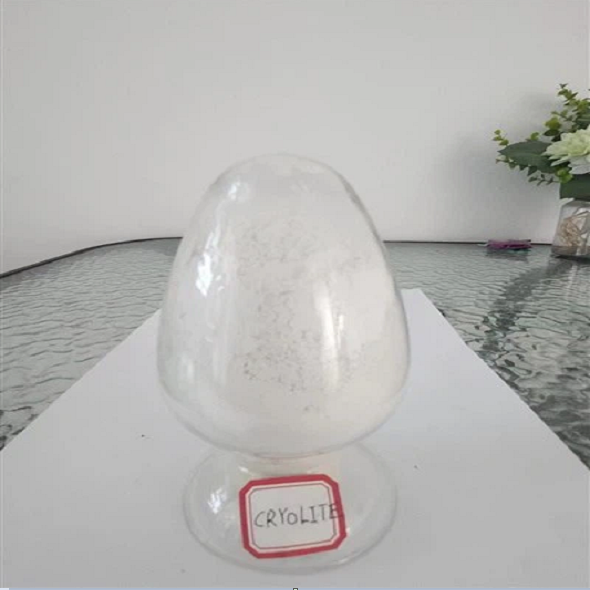
As an excellent abrasive additive, sodium cryolite has many advantages in the production of grinding wheels. First, it can increase the adhesion of the product, make the grinding wheel and the workpiece more firmly combined, and improve the stability and work efficiency of the grinding wheel. Secondly, sodium cryolite can also reduce the degree of burns on the cutting surface, effectively reduce the grinding surface temperature and oxidation degree of the grinding wheel, and protect the surface of the workpiece from damage. In addition, sodium cryolite can also accelerate the cutting speed of the grinding wheel, improve work efficiency, and extend the service life of the product.
Sodium cryolite has a neutral pH value in grinding and abrasives, which can reduce the dust raised by the resin grinding wheel during the grinding and cutting process, which is beneficial to environmental protection and the improvement of workplace hygiene conditions. In general, the unique composition and chemical structure of sodium cryolite make it an excellent abrasive additive, which can effectively enhance the grinding rate of the grinding wheel, improve work efficiency, extend the service life of the product, and protect the workpiece from damage, which is of great significance for the production of grinding wheels.
Zhengzhou Fanchuang Science and Technology Co., Ltd. is located in Zhengzhou City, Henan Province-the center of China's abrasive and grinding industrial. We are manufacturer of abrasive and grinding wheels. More than ten years development, we have gradually established various production to cover abrasive and grinding industrial. We have reached a leading level in the industry in terms of the quality of related raw and auxiliary materials, the processing efficiency of machine equipment, and the rationality of production processes, Our company is not only an approved supplier of well-known domestic abrasive tool manufacturers, but also has established cooperation with world-renowned abrasive tool companies in the Middle East and Southeast Asia. With stable product quality, timely supply, and technical support, we have received comprehensive praise from customers.

As one of the leading abrasive fillers materials manufacturers and suppliers in China, we warmly welcome you to buy cheap abrasive fillers materials in stock here and get free sample from our factory. All customized products are with high quality and competitive price.
sodium cryolite, onopa-gpf, abrasive fillers materials(0/10)



