




Tips for Solving 6 Common Surface Grinding and Cutting Problems
 Oct 08, 2025|
 Metal cutting and grinding are critical parts of many manufacturing and production operations, but common challenges can waste time and money and pose safety risks.
There are many abrasive products available to help you complete your work safely and correctly. Understanding how to select the right abrasive and following some key best practices can help operators overcome many common problems.
Understand the six major challenges of cutting and grinding and get tips for solving them.
1. Using the Wrong Abrasive
Operators often use the wrong abrasive because it has been a standard product in their operation. They may not be aware of better options. Using the wrong abrasive can affect productivity and increase safety risks. If operators "make do" with the wrong product, they may modify their technique or product to achieve the desired results, but this can introduce risks. For example, if an operator cuts down on a grinding wheel to improve performance, this can cause the wheel to break, creating a safety hazard.
Many different abrasive products are available in different styles and sizes. Not all grinding or cutting wheels are suitable for all jobs; some are designed for specific applications or materials. Understanding the differences between different abrasives and their intended uses can go a long way in resolving performance issues and optimizing efficiency. When selecting an abrasive, consider the application, material type, space constraints, tooling, and available power. For example, on a right-angle grinder, never use an abrasive wheel that cannot fit under the tool's guard, as this will require the user to remove the guard to attach it to the tool. Also, ensure the product's speed rating meets or exceeds the tool's rated speed. Avoid "feathering" with a cutting wheel, which typically refers to light grinding or deburring with the same wheel used for cutting.
2. Incompatible Product for Material
Carbon steel, stainless steel, and aluminum are three common materials used in manufacturing and machining. Stainless steel and aluminum are generally more challenging to cut and grind. When cutting or grinding these materials, it's important to avoid cross-contamination. Look for abrasives specifically designed for stainless steel or aluminum and labeled "non-contaminating." Avoid using products previously used on steel on these materials. Even if the product is designed for the specific material, doing so can introduce contaminants and cause surface rust.
Also note that excessive heat buildup during grinding can cause heat discoloration on stainless steel, potentially requiring removal or costly secondary processing. Another common challenge is aluminum, which has a lower melting point than steel. During the grinding or cutting process, aluminum can stick or create loads that adhere to the abrasive. To avoid this, choose a cut-off or grinding wheel specifically designed for aluminum. Not only are these abrasives free of contaminants, but their formulation also helps dissipate loads, preventing the operator from applying pressure and reducing efficiency.
3. Reaching Hard-to-Access Welds or Spaces
Whether grinding butt welds or fillet welds in tight areas, different weld types and space limitations present different challenges for cutting and grinding. If the weld is free of space, it's generally easier to get the abrasive into the weld. However, if there are obstructions or narrow areas, grinding becomes more difficult. Fillet welds are particularly challenging to grind because they often form a 90-degree angle. Many abrasive products won't fit into these spaces, or even if they do, they won't work effectively. When grinding fillet welds, choose a product with a curved shape, such as a flap blade designed specifically for fillet welds or a 16-gauge abrasive cone sized to fit the space. Smaller abrasives-cones, plugs, mixing discs, small-diameter cutting wheels, or mini flap blades-can also be used for cutting and grinding in hard-to-reach spaces. Available space also influences tool selection. In many cases, a right-angle grinder won't fit into tight corners, so a right-angle grinder or a cutting tool with abrasives may be a better choice. For speed and efficiency, a good rule of thumb is to generally use the largest abrasives and tools possible to maximize space efficiency.
4. Root Grinding of Multi-Pass Welds
In multi-pass weld applications, grinding the root (or weld pass) to achieve the correct results can be a challenge. The root pass is often ground while still hot, which can cause enamel to form on the grinding wheel. In this case, never chip or score the grinding wheel to reduce the enamel. This can cause the grinding wheel to break and create a safety hazard. Instead, look for a product designed specifically for grinding hot welds. Also, keep in mind that not all grinding wheels are created equal. Because the typical V-groove in multi-pass welding has limited space, and the root is always the first pass and located deep within the V-groove, 1/8-inch thick grinding wheels are often used. It's important to look for a product specifically designed to handle the scoring and typical grinding required during multi-pass welding. This will be noted on the wheel. Failure to understand the differences between these wheels can create safety hazards without the operator's knowledge.
5. Using a cutting wheel to Achieve the Correct Cut Depth
Cutting wheels are available in several options: Type 27 cutting wheels have a concave center, while Type 1 cutting wheels have a flat center. Cut depth is a key factor in deciding which cutting wheel to use. Cut depth is generally not an issue with Type 1 cutting wheels, but the raised hub of Type 27 cutting wheels can wear or even break if the operator cuts too deep. Use the largest diameter cutting wheel possible, but always consider the product design and workpiece to achieve the correct cut depth for the material thickness.
6. Cutting Thicker Materials
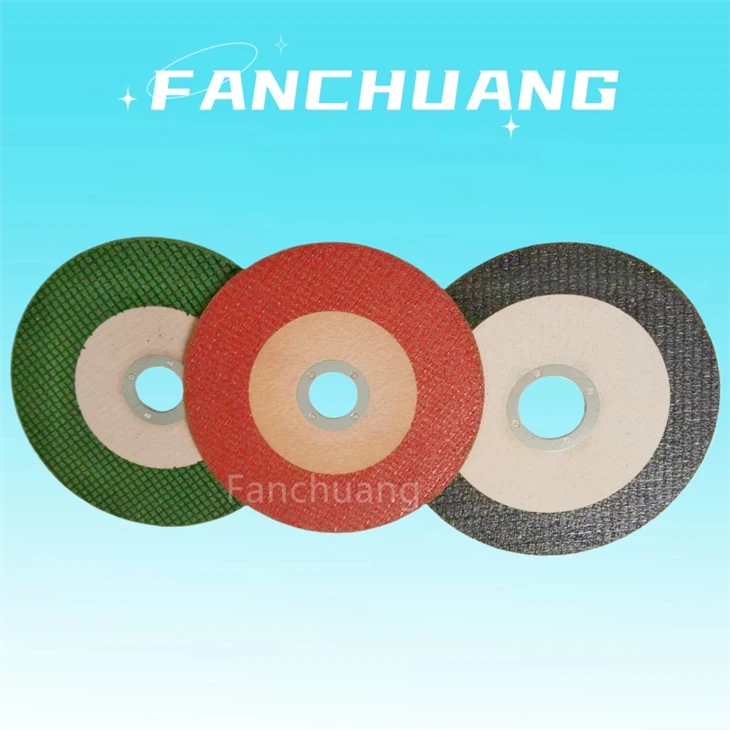
It is recommended to use a thicker cutting wheel for cutting thicker materials. cutting wheels are not one-size-fits-all. A wide range of thicknesses are available-from 1 mm to 3/32 inch is common. Thinner cutting wheels may be faster, but they often don't provide the best product life when cutting thicker workpieces, leading to more frequent product replacements.
Solving Cutting and Grinding Problems
Change can be difficult. However, considering whether the cutting and grinding abrasives are suitable for the job is often the first step in resolving common challenges and problems in metal finishing. Using abrasives designed for the material type, thickness, and application requirements can help save time and money in cutting and grinding.